the power of stories
The Ballad of the Last DragonThe power of stories is presented as an active force rather than a decorative feature of the narrative: stories alter what people remember, what communities believe, and how the dead continue to matter. Sylvaine Abelan discovers that storytelling cannot restore Aeron Fowler’s life or undo the losses surrounding his quest, but it can shape the meaning carried forward from them. Her decision to finish Aeron’s ballad makes narration both an artistic vocation and an ethical act of remembrance.
Storytelling as Identity and Commitment
Sylvaine’s resolve begins when she recognizes that Aeron deserves whatever she can still give him. She therefore commits herself to finishing his ballad and becoming the bard who will write it. The decision clarifies her identity more decisively than Jaromir’s promises or her hope for a fairer world: she understands herself as a storyteller, and Aeron’s story as something that must be told. Storytelling becomes a form of self-knowledge because the work she accepts reveals who and what she is.
That commitment also transforms grief into purpose without pretending that grief has disappeared. Sylvaine’s realization arrives in the cold light of a new morning, when something that seemed lost can still be found. The recovered thing is not Aeron himself, but a task, a voice, and a means of carrying his significance beyond the immediate circle of survivors. The story gives her a future action when personal certainty and emotional security remain unavailable.
Stories, Deception, and Belief
The discovery in the dragon’s cave provides the sharpest demonstration that a well-made story can govern reality long after its origin has vanished. The dragon is revealed not to be real in the expected sense, but to be a clever scheme devised by a dying man roughly a century and a half earlier to leave a lasting legacy and protect his wealth from town laws. The corpse-eaters deterred investigation, while the passage of time allowed the original account to fade into myth. The surviving date, 8:54 in the Age of the Wolf, places the deception more than one hundred and fifty years in the past.
The scheme’s force lies in its ability to recruit later people into its fiction. Aeron found an old map from a traveling merchant; what was a false trail for others became a path that Aeron’s companions followed until they began to believe in the dragon themselves. The map did not merely misrepresent a location. It supplied an object around which hope, danger, and faith could gather. When everything seems lost, the narrative suggests, belief in a meaningful story can become a comfort even when the story’s foundation is false.
This power is morally double-edged. The dying man’s tale protected his hoard, but it also helped produce a deadly chain of searches, traps, fire, and death. Sylvaine understands that many lives were claimed by the scheme, and the knowledge overwhelms her until she laughs hysterically through tears. The laughter marks the collapse of a story that had organized the expedition’s expectations: the apparent dragon quest becomes a historical fraud whose consequences are nevertheless real.
Rewriting Aeron’s Legacy
Sylvaine knows that Aeron did not die as the dragon-slaying hero the ballad can make him appear to be. He forfeited his life to protect a friend, yet the story she intends to sell will present him as the great hero who defeated a dragon. This alteration is not treated as a simple lie. It raises the harder question of where truth ends and fiction begins when a narrative gives a person a lasting public identity.
Aeron’s fate has already been altered by the tales Sylvaine tells. The ballad can preserve his courage and generosity, but it can also obscure the precise circumstances of his death. Its effectiveness depends on performance: Sylvaine needs a lute, needs to use every advantage available to captivate her audience, and intends to keep Aeron’s memory alive through the force of the telling. The rebuilt instrument made from Jaromir’s memories of watching her play becomes a practical tool for this work and a material link between artistic craft, intimacy, and memorialization.
The contrast between public and private storytelling keeps the ballad from becoming a single, complete account. Neith and Cadoc preserve parts of Aeron’s goat story by silently exchanging more than they are willing to say aloud. They treat that comic episode as a story worthy of protection from public consumption, demonstrating that withholding can be as deliberate as broadcasting. A story may spread until it takes on a life of its own, or remain guarded so that its meaning belongs only to those who shared it.
Stories as Living Afterlives
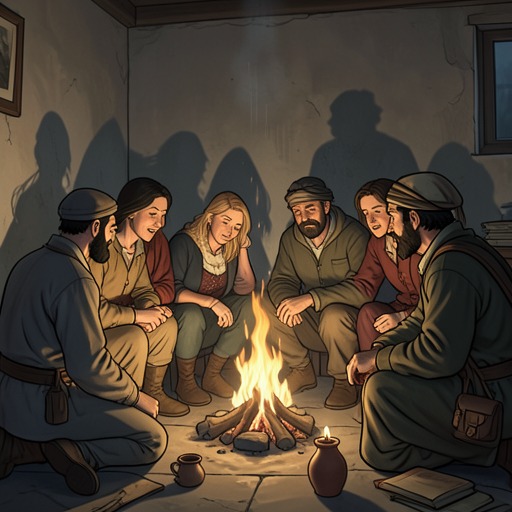
The book repeatedly treats memory as something made collectively. Aeron’s companions remember his fear, his humor, and his sacrifices; Sylvaine converts those memories into a ballad; and Neith reports that a memorial is being built for him. She plans to travel to it and pay her respects, showing that the story has moved from private grief into public commemoration. The memorial and the ballad are different forms of the same ongoing work: preserving a life by giving it a shape that others can encounter.
Yet the story remains open to revision. Sylvaine imagines that, with a quill and a convincing narrative, she might change the fates of the living as readily as she changes the account of Aeron’s death. That possibility is immediately limited by the impossible situation she and Jaromir face; a story can alter reputation and memory, but it cannot simply erase every material consequence. Its power is therefore neither omnipotent nor harmless. It changes the field in which people understand events, while the events’ costs continue to press upon them.
At the end, storytelling is still present even in happiness. Sylvaine reaches a home she once considered impossible, with Jaromir beside her, and recognizes that the moment itself contains the beginning of another ballad. She chooses not to write that one, perhaps keeping it for herself. The choice completes the concept’s emotional range: stories can be offered to the world to preserve the dead, guarded to protect intimacy, or withheld because some experiences are valuable precisely when they remain lived rather than performed.
Narrative and Thematic Significance
The power of stories binds the book’s major tensions together: truth and fiction, death and remembrance, private experience and public legend, and loss and belonging. The false dragon’s story shows how invention can create real danger; Aeron’s ballad shows how invention can create durable honor; the protected goat story shows how selective silence can preserve friendship; and Sylvaine’s unwritten final ballad shows that not every meaningful truth requires an audience.
The concept is also self-reflexive. Sylvaine is not merely inside a story about storytelling; she is an artist who consciously considers how tales are made, sold, altered, repeated, and inherited. Her work exposes the boundary between historical accuracy and emotional truth without dissolving the difference between them. The dragon never existed as the adventurers believed, but the fear, deaths, devotion, and courage produced by that belief remain part of the world’s history. In this sense, stories do not replace reality. They determine how reality survives in human understanding.